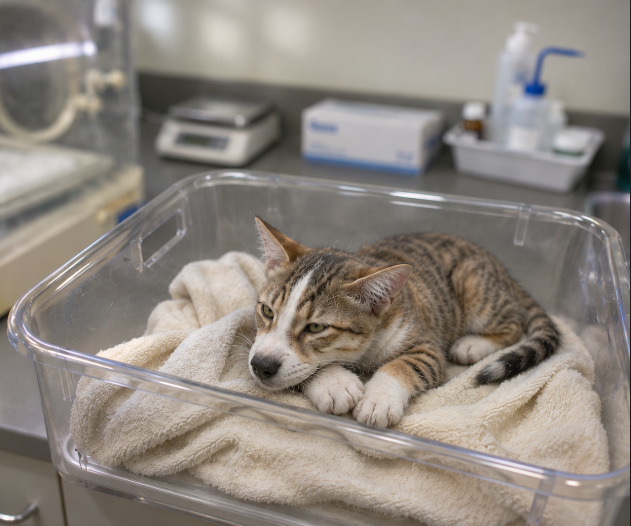
Researchers in Project Mosaic group have announced the birth of an animal containing living cells from both a dog and a cat. The newborn, named Mosaic, was delivered under veterinary supervision after a programme combining gene editing, stem cell biology and experimental embryo engineering. Preliminary examinations indicate stable breathing, normal feeding responses and steady weight gain.
The team classifies Mosaic as a canine-feline chimera: an organism in which cells from two species contribute to the same developing body. That is different from a hybrid. Conventional reproduction between dogs and cats is prevented by substantial genetic and developmental incompatibilities, so Mosaic is not the offspring of a dog and a cat.
"Within the context of our experimental programme, it represented an initial developmental milestone," said Dr. Elena Marlow, the principal investigator. "The next question is whether the animal can sustain healthy growth. A successful delivery is the beginning of that investigation."
"Our proposed classification is a canine-feline chimera," Marlow said. "That describes an organism containing cell populations originating from two species. Establishing where those cells are present, and what contribution they make, requires careful analysis."
According to the team, feline stem cells were able to participate in the development of a canine host embryo, and gene editing was used to investigate the cellular barriers that ordinarily prevent this. Analyses of several tissue samples detected both canine and feline cells. The researchers emphasise that Mosaic's appearance alone cannot show whether the experiment worked; that depends on examining her cellular composition.
For now, the veterinary team's focus is practical. "Her welfare," said Dr. Naomi Serrin, the veterinary lead. "We are concentrating on feeding, weight, rest and routine veterinary assessment. The excitement in the laboratory is considerable, but each observation needs to be recorded without exaggerating its significance."
In an internal message to the research group, Marlow asked colleagues to keep the birth separate from any conclusions about long-term viability, to describe the findings as preliminary, and to report veterinary observations and laboratory interpretations separately. Any claim about where feline cells are found, or what they do, must rest on analysis rather than appearance.
The team says a full manuscript will go through independent review, and that it will state clearly that a single animal cannot establish reproducibility. Questions about Mosaic's long-term health, immune function and organ development remain open, and the project provides no basis for breeding her or offering similar procedures.